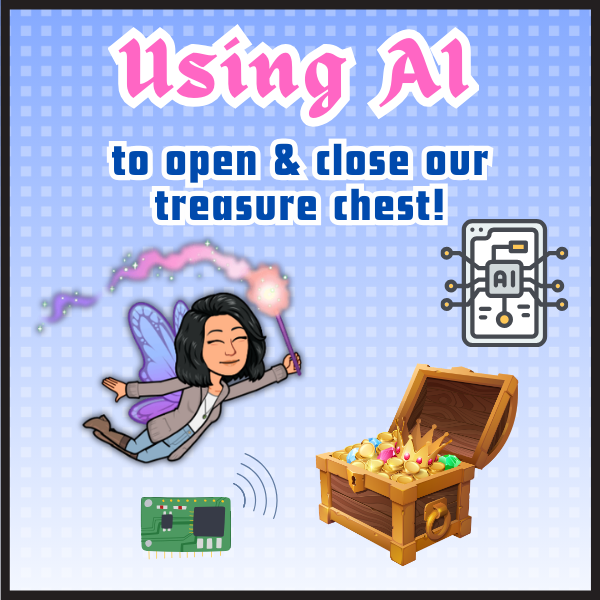
Some treasure is locked away with keys. Some with secret codes. Mine is guarded by artificial intelligence.
Recently, I set out to build something fun, interactive, and educational—a pirate-themed treasure chest made from cardboard that could open and close on its own. But instead of a simple switch, I wanted to give it a brain. That’s where micro:bit’s CreateAI came in.
From Cardboard to Codeboard
The project began as a simple stop-motion build. I cut, folded, and glued layers of cardboard into the shape of a chest. It had the classic pirate feel: arched lid, gold accents, and plenty of space for “loot.” But the real treasure was still to come: wiring and programming the brain of the operation.
Step 1: Physical Computing I wired the micro:bit to control a small servo motor, which would physically lift and close the lid. This is where physical computing shines by combining mechanical design, electronics, and code to make something tangible come alive.
Step 2: AI Training with CreateAI micro:bit’s CreateAI allows you to train a model to respond to real-world inputs. In my case, I trained the system to recognize specific inputs or patterns that would tell the chest to open or close. Instead of a password or button, the AI “learned” when to trigger the servo.
Step 3: Integration Once the AI model was trained, I programmed the micro:bit to listen for the AI’s signals and activate the servo motor. The result? A pirate chest that reacts like it has a mind of its own.
Why This Project Matters
Yes, it’s a fun build, but it’s also a hands-on lesson in future-ready skills.
Students who work on projects like this aren’t just “playing” with electronics. They’re learning:
Physical computing fundamentals: wiring, circuits, and controlling hardware
AI & machine learning basics: training models to respond to data
Creative problem-solving: taking an imaginative idea and turning it into a working prototype
Interdisciplinary thinking: blending storytelling, design, and engineering
The Educational Treasure
AI might seem like an abstract, far-off concept, but projects like this bring it into the real world – literally into students’ hands. They see how algorithms can interact with physical devices, and they begin to imagine new ways to integrate AI into everyday objects.
Plus, the pirate theme sparks creativity. Students start thinking: What if the chest had a security system? What if it played a sound when opened? Could it only open for certain people?
That curiosity is the true treasure.
Take a look at this use of AI + machine learning: a pirate treasure chest that opens and closes on its own, trained with micro:bit’s CreateAI. Physical computing meets the high seas! 🏴☠️🤖 @microbit_edu #AI #STEM #microbit