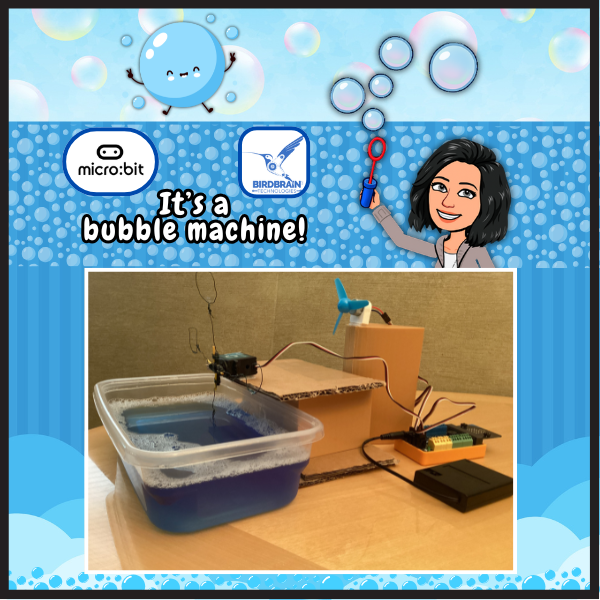
Bubbles are more than just entertainment. Behind every floating sphere is a lesson in surface tension, air pressure, and the properties of liquids and gases. A bubble machine provides an easy, engaging way to bring these concepts into the classroom or makerspace while keeping learning hands-on and fun.
The Science Behind the Machine
A bubble machine demonstrates simple engineering principles in action:
- Rotation and Dipping – A wheel or set of wands rotates through a bubble solution.
- Airflow – A fan directs air through the soap film, forming bubbles.
- Continuous Output – The cycle repeats, producing a steady stream of bubbles.
In this process, students can see how mechanical systems and basic physics combine to produce a real-world effect.
Learning Opportunities
Bubble machines naturally spark curiosity, and teachers can leverage that curiosity to explore key STEM topics:
- Physics – Investigate surface tension, evaporation, and how air pressure shapes each bubble.
- Chemistry – Experiment with different bubble solution recipes and test which mixtures create stronger or longer-lasting bubbles.
- Engineering & Design – Challenge students to improve the machine’s performance by adjusting wand size, fan speed, or solution type.
- Math – Measure bubble size, count output over time, or estimate how long a batch of solution lasts.
Why This Activity Works in Education
- Hands-on Engagement – Students actively test, observe, and refine their ideas.
- Collaboration – Building or running a bubble machine encourages teamwork.
- Real-World Connection – Everyday play becomes a vehicle for understanding scientific principles.
Bringing It Into Your Classroom or Makerspace
Teachers don’t need elaborate equipment to get started. A simple store-bought bubble machine can introduce the concepts, while a DIY build can become a full engineering project. Pair the activity with guiding questions, such as:
- What factors make bubbles last longer?
- How does changing the airflow affect bubble size?
- Why do bubbles eventually pop?
These questions shift the focus from entertainment to exploration, helping students connect what they see to what they learn.
Final Thoughts
A bubble machine is more than a novelty. It’s a portable STEM lab. With a mix of play and purpose, it turns ordinary bubbles into opportunities for inquiry, problem-solving, and discovery.
Want the full classroom experience?
We’re currently building the complete lesson package for this project —
including student worksheets, guided instruction, and grading rubrics.
These materials will be available to premium members soon.