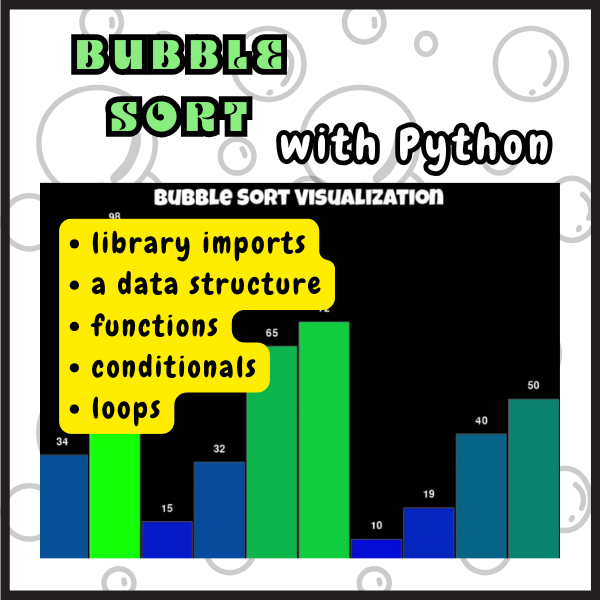
What happens when you mix Python, Pygame, and a fundamental sorting algorithm? A powerful visualizer that brings code to life!
Algorithms are the backbone of computer science, but learning them from a textbook can feel abstract and difficult. I wanted a better way to understand how a bubble sort actually works, so I decided to build a visualizer to see the process in real time.
The Challenge of Visualization
Imagine trying to explain a bubble sort without a diagram. You’d talk about comparisons, swaps, and passes, but the real magic is in the movement of the elements. I knew a graphical representation would make the concept click, which is why I turned to Pygame.
The Solution: A Live Demo
Pygame was the perfect tool for this project. Its simple drawing primitives made it easy to represent each number in the list as a colored bar. I connected my core bubble sort logic to the drawing loop, so every time the algorithm made a comparison or a swap, the screen would update to show the change.
What I Learned
This project wasn’t just about the end result; the process itself was a powerful learning tool. It reinforced my understanding of Python functions, conditional logic, and how to manage a game loop. It also gave me a newfound appreciation for the visual side of programming.
The bubble sort may not be the most efficient algorithm, but watching it in action makes its simplicity and elegance clear.
Get the Code
If you’re interested in using this project as your own learning tool or just want to see how it works, you can find the full code and a demo below. Just click the run button and after the page loads, press the space bar to watch the sorting process.
Latest Posts